At first glance, History and English seem two studies diametrically opposed. One studies reality, and the other is fiction. Nevertheless, the two are intimately connected and interdependent.
Tolkien wrote much on the issue of subcreation. Man is made in the image of God, he said, and one of the ways he imitates God is in his ability to create things, be it art or stories or other things. This is why Tolkien wrote the Silmarillion and the Lord of the Rings; his creation was a prayer to honor the Lord, the Creator of all.
Visual art's relationship with the created material order parallels literature's relation to history. Both visual art and literature are meant to reflect reality through a lense, which is the perception of the artist or author, in order to accentuate different facets of God's creation and cause man to wonder at His beauty.
Good literature draws its power and nobility from history, just as a painting reflects the material world. History is God's fiction, and when man creates stories he subcreates based on God's stories.
We often think of history as a memorization of dates and dry facts, totally opposed to imagination and creativity. Yet, in reality it is the source of our ideas of drama, adventure, romance, suspense, and happy endings.
We're all characters from the mind of God.
Wednesday, November 08, 2006

Wednesday, October 04, 2006
Priests
Isn't it odd to think of a priest listening to modern music? Or watching sports on TV? Or telling bawdy jokes? In other words, isn't it odd to think of a priest being just like you? Probably a good idea would be to take your idea of what a priest's lifestyle should be--ascetical, filled with prayer, spiritual reading, uplifting conversation, utter devotion to God--and realize this would actually fulfill your desires. Priests, after all, are just as busy as the rest of us. They do not live the contemplative, but the active life. Yet, they must make time for prayer and must order their lives toward seeing God in order to fulfill the duties of their vocation. The same goes for all of us!
Wednesday, September 27, 2006
Love
It seems to me that love must be placed firmly in the present. One of the most dangerous ideas is that your love will increase in the future. This does not equal a 'firm purpose of amendment,' for even that begins in the present--I will change now. If your love does not have that character of unselfishness, disinterestedness, pure giving and devotion, resolve this minute to make it so. We cannot afford to procrastinate our lives, which after all are only a gift. Nothing will come along to solve all our problems; this can never be, for the very problems and struggles we face form part of the gift of our lives. The only answer to anything bad, anything that hurts or stings, anything that shocks or buffets, is to love.
Saturday, September 02, 2006
Blog not dead, just working on thesis
Most, if not all, the members of this blog have now begun a new adventure: writing a senior thesis. This venture will take a long time for some, but for others (like me) it will be a lot of fun and will end soon after fall break. Right now, I have a cold and I don't want to do anything. That is probably why I am posting this. It is a mixed blessing to get sick on a Friday night. The positive aspect of it is that, ideally, you can rest up and recover by the time classes start again on Monday. The negative aspect is that you don't, you spend a lot of time wasting time and feeling sorry for yourself, you don't study or do your homework as well, you can't sing in choir, and you feel antisocial because you imagine that the ickiness you feel translates into a similar ickiness in outward appearance, causing an insurmountable insecurity when talking to anyone but one's closest and most sympathetic friends. Another positive aspect that I forgot to mention, however, is that by enduring illness without complaint and with a cheerful disposition one can grow in virtue and imitate Christ. I think I tend to forget about this positive aspect of being sick when I get sick myself, and if someone else is sick I certainly don't remind them of it. "Offer it up" is pithy, but hardly consoling, right? Still, life goes on, some people are sick all the time and I'm just going to be this way for a week or so (I hope). Ciao!
Sylvia
Sylvia
Wednesday, August 16, 2006
A day at work
"Man is preoccupied with freedom yet laden with handicaps. The breadth of his activity and experience is narrowed by the limitations of his relatively weak, sluggish body.
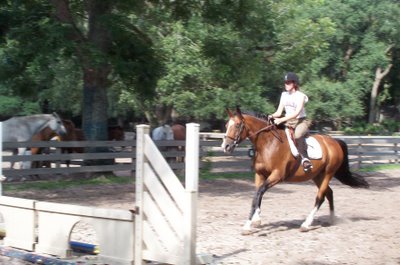
The horse, by virtue of his awesome physical gifts, freed the jockey from himself.
 When a horse and jockey flew over the track together, there were moments in which the man's mind wedded itself to the animal's body to form something greater than the sum of both parts.
 The horse partook of the jockey's cunning; the jockey partook of he horse's supreme power. For the jockey, the saddle was a place of unaparalleled exhiliaration, of transcendence.
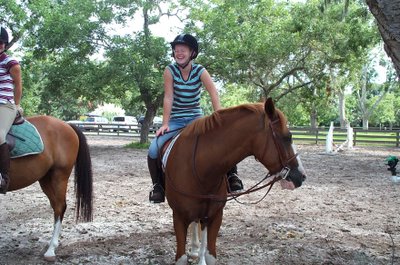 On the ground, the jockey was fettered and muted, moving in slow motion, the world a sensory vacuum after the tenfold high of racing speed.
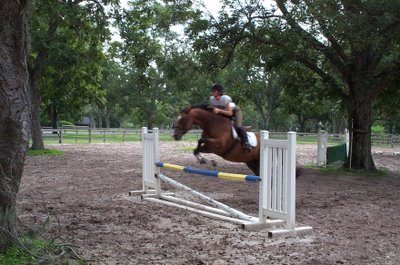
The horse, by virtue of his awesome physical gifts, freed the jockey from himself.
 When a horse and jockey flew over the track together, there were moments in which the man's mind wedded itself to the animal's body to form something greater than the sum of both parts.
 The horse partook of the jockey's cunning; the jockey partook of he horse's supreme power. For the jockey, the saddle was a place of unaparalleled exhiliaration, of transcendence.
 On the ground, the jockey was fettered and muted, moving in slow motion, the world a sensory vacuum after the tenfold high of racing speed.
In the saddle, emancipated from their bodies, all reisnmen sailed eight feet over the world, emphatically free, emphatically alive. They were Hemingway's bullfighters, living 'all the way up.'"
-Laura Hillenbrand, Seabiscuit: An American Legend
Monday, August 14, 2006
St. Maximilian Kolbe, Priest and Martyr
 Today is the feast day of the great St. Maximilian Kolbe. A biography records: "On 28 May 1941 he was transferred to Auschwitz and branded as prisoner 16670. He was assigned to a special work group staffed by priests and supervised by especially vicious and abusive guards. His calm dedication to the faith brought him the worst jobs available, and more beatings than anyone else. At one point he was beaten, lashed, and left for dead. The prisoners managed to smuggle him into the camp hospital where he spent his recovery time hearing confessions. When he returned to the camp, Maximilian ministered to other prisoners, including conducting Mass and delivering communion using smuggled bread and wine.
"In July 1941 there was an escape from the camp. Camp protocol, designed to make the prisoners guard each other, required that ten men be slaughtered in retribution for each escaped prisoner. Francis Gajowniczek, a married man with young children was chosen to die for the escape. Maximilian volunteered to take his place, and died as he had always wished - in service."
My love for St. Maximilian has increased after visiting Auchwitz last year. The inhumanity of concentration camps has been described by many survivors, yet this man was able to act in a superhuman and heroic fashion amidst extreme hate, ugliness, and death. After he and the 9 other men were locked in the starvation bunker, the guards, so used to hearing screams and cursing heard instead prayers and singing. St. Maximilian, Knight of the Immaculate, was also full of grace. His life should remind us that Our Lady will give us power to overcome the strongest powers of evil, if we only allow her to work in us. St. Maximlian Kolbe, pray for us!

The room where he died.
Courage, my sons, Don't you see that we are leaving on a mission? They pay our fare in the bargain. What a piece of good luck! The thing to do now is to pray well in order to win as many souls as possible. Let us, then, tell the Blessed Virgin that we are content, and that she can do with us anything she wishes.
-Saint Maximilian Kolbe
No one in the world can change Truth. What we can do and should do is to seek truth and to serve it when we have found it. The real conflict is the inner conflict. Beyond armies of occupation and the hecatombs of extermination camps, there are two irreconcilable enemies in the depth of every soul: good and evil, sin and love. And what use are the victories on the battlefield if we ourselves are defeated in our innermost personal selves?
-Saint Maximilian Kolbe in the last issue of the Knight
Saturday, August 12, 2006
CD's

Gaelic Storm has a new album out, and it's great! It is almost, if not as good as their last "How Are We Gettin' Home?" There are songs about gypsies, beer, sea journies, Johnny Tarr, and other eccentrics (Kevin Kelly!), plus some good traditional reels. And, as usual, their clever lyrics are hilarious. The only dissapointment was they did not insert their comments about their songs in the CD jacket. For me, that was one of the highlights of past albums. ("Gainful employment is for the birds!") Also, in the past they have put in a synopsis of the story for the Irish-language songs, so you know the song is about the high-spirited goat or the Irish boy who fell in love with a redhead andattempted to woo her with poetry such as "I prefer her to cows", but this time around, "De Luain, de Mairt" is left to our imaginations. Nevertheless, it's a great album. I hope I get to see Gaelic Storm live one day--I've heard they're good in concert.
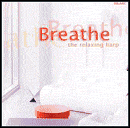
The other CD I added to my collection is "Breathe: The Relaxing Harp," which features the talent of Yolanda Kondonassis. I have never heard of her before. She put together a nice collection of Debussy, Vivaldi, Chopin, Bach, and Ravel, to name a few. Chopin via the harp is very different. Despite the really freaky interior design on the front cover it is a lovely album.
Thursday, August 10, 2006
Cool Quotes
I don't usually pass on sayings or "words of wisdom," but I think these people really had something to contribute to society. Their words are definitely worth considering. Plus, they are just great quotes.
______________________
"Just because your voice reaches halfway around the world doesn't mean you are wiser than when it reached only to the end of the bar."
" The madman is not the man who has lost his reason. The madman is the man who has lost everything except his reason. "
"A man who is eating or lying with his wife or preparing to go to sleep in humility, thankfulness and temperance, is, by Christian standards, in an infinitely higher state than one who is listening to Bach or reading Plato in a state of pride. "
--C. S. Lewis
"If you can't feed a hundred people, then feed just one."
______________________
"Just because your voice reaches halfway around the world doesn't mean you are wiser than when it reached only to the end of the bar."
--Edward R. Murrow
" The madman is not the man who has lost his reason. The madman is the man who has lost everything except his reason. "
--G. K. Chesterton
"A man who is eating or lying with his wife or preparing to go to sleep in humility, thankfulness and temperance, is, by Christian standards, in an infinitely higher state than one who is listening to Bach or reading Plato in a state of pride. "
--C. S. Lewis
"If you can't feed a hundred people, then feed just one."
--Mother Teresa
"The great danger for family life, in the midst of any society whose idols are pleasure, comfort and independence, lies in the fact that people close their hearts and become selfish. "
--Pope John Paul II
--Robert E. Lee
"The great danger for family life, in the midst of any society whose idols are pleasure, comfort and independence, lies in the fact that people close their hearts and become selfish. "
--Pope John Paul II
"The devil's name is dullness."
--Robert E. Lee
Tuesday, August 08, 2006
Catholic Radio
Do any of you listen to Relevant Radio? Its a growing Catholic talk radio station that I find quite exceptional. Although we don't have any local channels carrying it in FR, I listen to it online live at www.relevantradio.com. (Bishop Sheen on 10-11 and Fr. Coropi 11-12!)
Monday, August 07, 2006
Fathers and Sons
If there is one thing that completely baffles me, it is the relationship between fathers and their sons. I cannot wrap my mind around why it is that sometimes they just do not get along. However, I will attempt to gain more understanding on this subject by reviewing the case. In my limited experience of the workings of the father-son relationship, I have gleaned a few facts about it. One, fathers expect a lot from their sons. Somehow, all that is wrapped up in being a man, all that it took the fathers themselves years to learn and digest, should immediately begin to take root when a son reaches pre-adolescence. As Aristotle puts it, "Men have a natural desire to leave behind an image of themselves." Unfortunately, too often I think the father imagines he is a much better example than he really is and therefore his expectation of his son's excellence becomes even more unreasonable. I don't say that to judge, but simply to point out that children pick up the bad habits of their parents twice as fast as they pick up the good ones. This is all the more true in sons, who really do idolize their fathers as masculine role models, to an extent that I think even they do not realize. This leads me to my second observation, that sons cannot bear to disappoint their fathers. A young boy's reaction to the expressed disapproval of his father is usually to cry, but as the boy grows older he no longer feels he has this recourse. Therefore, his frustration at his perceived inability to please his father vents itself in fits of temper and defiance. Should the son be honest with himself about why he feels the way he does about his father? Sure he should, and he should also keep in mind St. Paul's injunction in Colossians 3 to "obey your parents in all things;" in trying to please his father, a son's true aim should be pleasing God. In rebuking his son, a father should take even more to heart St. Paul's words, "Fathers, provoke not your children to indignation, lest they be discouraged." Parents have the responsiblity to encourage their children in virtue, and they must take into account the impact their words or actions have on their children. After all, they are adults, whereas the children are just children. However, the third thing is that it is extremely difficult for men to express affection for each other, and when applied to the father-son dynamic already discussed, this may prove the solution to the strained situation that results from both parties' natural pride (as a side point, Dr. Phil has said that one of the key facets of the male character is pride--and though I will not attempt to argue that men are prouder than women, it certainly does solve a lot of things to consider that most men do struggle to keep their opinion of themselves very much afloat). Fathers simply must tell their sons that they are proud of them, that they have done a good job, that their efforts have been noticed, that they love them ultimately, or else they are failing in their job as parents. I know that the confidence I have in the world stems in no large part from my dad having given me these words of encouragement, and it pains me that he has such trouble doing the same for my younger brother. I can try to see why, but I still find it unfair. My mom cannot make up for this lack on my dad's part, because it just isn't the same to have a mother's esteem and affection. Although equally necessary, there is always a sense that mom loves you just because she is mom and it is her office to love, whereas with dad it is more because you have proven yourself. This too is a delighful illusion, because a good father's love is as unconditional as a good mother's. On the other side of the coin, sons should also make an effort to tell their dads that they are sorry for their failings, that they look up to them and need their help, that they love them as well. I don't know how this may be done, to be honest, but from my womanly perspective I can't see how a relationship between any two people can thrive without at least occasional words of love, in some form or another. So to conclude, life is hard. Life is hard for boys and men, and it is also hard for women who must perpetually resist the impulse to tell them what to do (which is exactly what I have done here). If there is anything men cannot stand, it is to receive commands from a woman, so always phrase it as a request or suggestion. That one came out of nowhere. Ok, and with that, my "deep" thoughts have come to an end. :)
_~Sylvia
_~Sylvia
Sunday, August 06, 2006
Ode to Christendom Drinkers
After having lightly partaken of my own particular favorite, I thought I would add an ode to Christendom drinkers. It ain't good, and it ain't metered, so don't even look fer it. I also can't seem to reconcile Belloc's "think it no sin to drink 'til they spin" with the teaching of the Catholic Church. But it does seem to be a pervasive belief at Christendom.
Here be to ye all, ye swillers of booze,
Who swiftly run empty yer liquor container
And run off yer mouth however ye choose
Ye one-hundred-proof ad-hoc entertainer.
Ye think 'cause yer Catholic that ye can be drunk
And it's part of the Faith that ye stumble about
Because of yer quaffing yer grades have all sunk
And ye've proven yerself a damnable lout.
But ye've got yer comrades, aye, s'long as they last
For drunkards ain't known to remain solid friends
They poison their brains wi' a tip o' the glass
And head toward their deaths as the drunkard's path tends.
So lift up a glass and give toast to the sot!
They've all drunk up deep and are all feeling well
They choose being sloshed as their portion and lot
And sing all the glories of living in hell.
Odes to Wine
Happy Transfiguration! Due to the family reunion (of the Italian side), I consumed a large quantity of that congenial beverage (to quote Amelia Peabody) we call wine, and also not a little beer. So, a few odes to wine and beer, all by Hilaire Belloc.
Drinking Song, On the Excellence of Burgundy Wine
My jolly fat host with your face all a-grin,
Come, open the door to us, let us come in.
A score of stout fellows who think it no sin
If they toast till they're hoarse, and drink till they spin,
Hoofed it amain
Rain or no rain,
To crack your old jokes, and your bottle to drain.
Such a warmth in the belly that nectar begets
As soon as his guts with its humour he wets,
The miser his gold, and the student his debts,
And the beggar his rags and his hunger forgets.
For there's never a wine
Like this tipple of thine
From the great hill of Nuits to the River of Rhine.
Outside you may hear the great gusts as they go
By Foy, by Duerne, and the hills of Lerraulx,
But the rain he may rain, and the wind he may blow,
If the Devil's above there's good liquor below.
So it abound,
Pass it around,
Burgundy's Burgundy all the year round.
Catholic Sun, The
Wherever the Catholic sun doth shine,
There’s always laughter and good red wine.
At least I’ve always found it so.
Benedicamus Domino!
The Pelagian Drinking Song
Pelagius lived at Kardanoel
And taught a doctrine there
How, whether you went to heaven or to hell
It was your own affair.
It had nothing to do with the Church, my boy,
But was your own affair.
No, he didn't believeIn Adam and Eve
He put no faith therein!
His doubts began
With the Fall of Man
And he laughed at Original Sin.
With my row-ti-tow
Ti-oodly-ow
He laughed at original sin.
Then came the bishop of old Auxerre
Germanus was his name
He tore great handfuls out of his hair
And he called Pelagius shame.
And with his stout Episcopal staff
So thoroughly whacked and banged
The heretics all, both short and tall --
They rather had been hanged.
Oh he whacked them hard, and he banged them long
Upon each and all occasions
Till they bellowed in chorus, loud and strong
Their orthodox persuasions.
With my row-ti-tow
Ti-oodly-ow
Their orthodox persuasions.
Now the faith is old and the Devil bold
Exceedingly bold indeed.
And the masses of doubt that are floating about
Would smother a mortal creed.
But we that sit in a sturdy youth
And still can drink strong ale
Let us put it away to infallible truth
That always shall prevail.
And thank the LordFor the temporal sword
And howling heretics too.
And all good things
Our Christendom bringsBut especially barley brew!
With my row-ti-tow
Ti-oodly-ow
Especially barley brew!
Wednesday, August 02, 2006
Welcome!
I must be very slow in the uptake, for I just noticed that Emma has joined us. I'm so glad. The more Texans the better.
Today I'm in the middle of a family reunion. My dad's 4 sisters and their families have come to SC, and rented a really nice house with a roulette table! I'm so excited--I've never seen a real one before (roulette table, that is). I think it's meant to be decoration, but my brother and I have been making use of it. 4 of my 8 cousins have come. So fun.
To make good chicken salad, add:
some chicken (duh)
some celery, chopped small.
some grapes, red or green, chopped in quarters
pecan pieces
and mayo.
It's delicious!
Does Anyone Else Think This Mel Gibson Thing is Dumb?
I don't read tabloids. Even considering my profession, I make it a standing point to steer clear of the petty foibles and misdemeanors of celebrities, as well as the inevitable surrounding gossip. But this is different. I picked up a copy of USA Today to read actual news, and there, nestled comfortably in the front page, was Mel Gibson's sheepish, hung-over face. So I read the article. Sorry, maybe that suggests a lack of personal discipline on my part.
Many media moguls, as well as leading Jewish authorities, are seriously considering boycotting Gibson's work. To what end, I know not, but they hold that the anti-Semitic comments Gibson made while drunk off his bum were important enough to warrant this.
All I can say is, get a life. Mel Gibson is not a religious leader, nor is he a political one. He's a celebrity. When he goes out and does naughty or stupid things, it makes news headlines and editorials. Unfortunately, that's the way our world operates. That shouldn't affect our opinion of his work, which, as art, stands on its own. Nor should disillusion or dishearten us as human beings. Mel Gibson is a Hollywood celebrity, he's not Mother Teresa or Pope John Paul II. In a deeply committed and heartfelt act, he made a film called The Passion of the Christ. For that, he is to be commended.
I don't admire Gibson or look up to him. Even as someone who is neccesarily caught up in the importance of film and media, I think that things have gotten a bit out of hand when some famous celebrity's drunken comments stir a national controversy. Let's keep it real, people.
Tuesday, August 01, 2006
Culled from the blog world
I found this recent post on one of my favorite blogs, Dappled Things, and had to share it with all of you, particularly those discerning the vocation to marriage.
Monday, July 31, 2006
Le Chasseur Maudit sighted!; Josepha goes barefoot

This exclusive photograph provides a rare glimpse of the man known by some as Le Chasseur Maudit and by others as Jonathon or Johnathan. The red arrow points to the visage of this infamous reporter, as he apparently embraces and holds hands with a young woman while both gaze romantically off into the distance. Sources have confirmed the young woman in the picture to be no other than Josepha Bertolini, recently the subject of an article on Le Chasseur Maudit's Academy News. The blue arrow indicates Miss Bertolini's bare feet; the fact that she eschews shoes has fueled speculation that she has paid extravagant sums to Jonathon in order to advertise her blog on the Academy News website.
Chorus
Well, we cut in the last shot of Chorus last night, and the film clocks in at nearly 3 hours. Since max running time has been specified as 1 hr, 50 min, we have our work cut out for us, so to speak.
Anyway, otherwise things are going well. 27 days and counting to premiere. We can do this.
Anyway, otherwise things are going well. 27 days and counting to premiere. We can do this.
Saturday, July 29, 2006
An Apology for Liturgical music and High Standards
As a one of a kind event, I now propose to post for a second
consecutive day. Before I go further, I apologize for the lengthiness of this post. I will try to prevent it from happening again, but there is so much to be said. In light of the recent controversies, I am sure that if we wanted to, we could think up a few more controversies, and turn it into a forum. Anyway, I don't know what others think, but I would like to have those who respond to articles to post them as new articles, if possible. Maybe I am strange, but I prefer the discussions to be public, and easier to reference.
Today I will briefly respond to Geoff's post. I am not in total disagreement, but I did want to respond to several things that he had to say. First, I must acknowledge that too many Traditionalist Catholics are prone to being critical, suspicious, and even holier-than-though. Sad
to say, the aforementioned type of Catholic seems to focus on problems in the Church, failings of Bishops and priests, and even to finding and maintaining all kinds of ridiculous conspiracy theories concerning the Papacy and Church. Needless to say, they are as true a bane to the good
of the Church as are those liberals who care about nothing but making the Church an instrument of social justice. One minor caveat I do have to say is that damaging as they may be, and wrong as they may be, such problematic Traditionalists have one benefit; that they do want to restore much of what the Church has lost. This is perhaps small recompense for the trouble they cause, but I think that I prefer them to liberals as an influence in the Church. That being said, I think that objectively speaking, a person who acts in such a way has more to answer for in relation to his disobedience and lack of charity. Such a person has real knowledge of the true and the good (in theory) and in deviating from it are worse off than those who don't know better. That was slightly longer than I intended, but onto the next lengthy point. I suppose I need to make up for the lack of posts that I have put on here in the past. I thought Geoff's image about sitting on the edge of the Bark of Peter especially apt, and rather clever, in fact. I do want to say that I think a major point missing from his comparison of the Novus Ordo and Tridentine masses is their organic nature. Whatever beef (unintended humor) you may have with the Tridentine mass, it grew naturally, for the mostpart, from the first masses of the Apostles. The vestments, the liturgical gestures, the postures, etc., all arose out of contact with the civilizations surrounding Christianity, but were incorporated slowly and with care for the liturgy. A brief comparison of the Eastern and Western Rite liturgies with ancient Jewish liturgical practice shows very much in common among all three. (It would take far too long to describe these, but many similarities, especially in structure and language, exists.) The uniformity of the Western Rite arose because the many 'rites’ or usages within it dropped their practices in the face of Protestant revolt, to demonstrate loyalty to Rome. However, the Roman Liturgy had been since the 400's that upon which others were based. In fact, much of the liturgy as we know it was in place at that point in
history and had to be restored to Rome after Barbarian raids on the city by Frankish visitors. At any rate, the liturgy of Pius V was primarily a codification of the existing norms from the times of Gregory the Great. This lengthy deviation from the topic, so I hope, demonstrates the organic nature of the Tridentine mass. The new mass, however, was a significant deviation from long standing liturgical practice. Many of the elements central to the Novus Ordo (Vernacular, ad Populam, lay interaction, etc.,) may have been extant in the Early Church, but as the new generation of liturgical experts failed to note, were mostly phased out early on in liturgical history because they were not most fitting for the liturgy. These experts, following Hans Kung and other liberal/liberation theologians, even denied that the Liturgy should be sacral and removed from contemporary culture in any way. They explicitly desired to make the Mass like ordinary life and society: simplistic, ordinary, convivial, and comfortable to a generation of uncomfortable Catholics. Keep in mind that these same theologians also felt free to deny various principles of Catholic Dogma, including but not limited to Papal Authority, Church teaching on abortion and contraception. Others of their persuasion openly rejoiced at "Hootenanny" and folk masses. There is, sadly, a clear correspondence between the implementation of the Novus Ordo as we know it, and the liberal and dissident theologies plaguing the Church to this day. That being said, I do want to reiterate that this does not in one whit hange the nature of the Mass itself, nor could such changes ever do so unless formal and material changes to the nature of the Mass itself. I do believe and hold that said changes were hasty and ill-advised (both literally and idiomatically), and that the resulting liturgy, especially with its looser guidelines, proves all too open to human manipulation and desacralization. Lastly, I wish to say something about music. (Minor deviation: Not all the applications of symbolism to vestments were after the fact. The
Sabbath did pre-exist man, after all. Jewish priests wore holy robes, and the cincture or belt or rope has been a symbol of purity since before Christ.) This is truly the gist of my disagreement with Geoff, though I strongly suspect it is more in practice than principle. First, lamentable as it may be, there is the standing joke in choir--any choir, not just ours--about the singing of the congregation. I say that this is for the sake of humor; the choir is human and needs to laugh, especially when faced with its own insufficiencies. In truth we all tend to do this in any circumstance, comparing ourselves to that which is below us. While this is often wrong, and does often stem from pride, it is not malicious. Nor is it aimed at anyone in the congregation or any person at all. As I said it is much more of a way of relieving stress. Again, this is not to deny that musical snobbery does not exist, nor that choirs or choir members are not human and subject to pride. This post has gone on too long; I only hope someone may read it and debate points or find
relief of mental stress. To conclude: some kind of musical snobbery is necessary. Especially since 1968 (which Pope Benedict calls the "second Enlightenment") the musical standards for the liturgy, never high in this country, have died and headed south. Or west. Anywhere but here. But, since ancient times, even the very earliest days of the Church, music (psalms, hymns, etc.) have been an integral part of the Holy Sacrifice of the Mass. Thus, to love true liturgy, which Pope Benedict said is the source of the fortunes of the Church, is to love liturgical music. And
to love is to hold to a high standard, for even so we are held to high standards by our own Creator and Redeemer. There must always be someone to hold others to a higher standard, whether as ruler or authority of any sort. These figures are frequently reviled and held to contempt by others, quite possibly due to the relativism and individualism of our day. Nonetheless, in holding the liturgy and its music to a high standard and trying to help and promote it wherever possible, such people do a necessary and good service. This does not excuse intellectual pride and belittling of others by such people, yet it does not excuse them from duty, and certainly should not (as such) be a cause for criticism of the same people. As a sacristan, member of choir and schola, as well as a Traditionalist and faithful Catholic, I thus defend
myself. God bless, and please respond if you have any comments or questions.
Friday, July 28, 2006
Divine Retribution.
The Christendom world is abuzz with this new video game rule. Personally, I'm withholding judgement on the whole situation for the moment.
However, there is one possible explanation for this scourge. It is punishment from God for burning the Wall Flower. Men (who shall not be named) did this heinous deed, and now they are being punished. Perhaps a prophet will appear wandering up and down 134 Christendom Drive at 12 miles an hour, calling for repentance, sackloth and ashes, and fasting. Or, if everything we learned at that blessed institution is false and the Aztecs were right, maybe there will be a sudden demand for human sacrifice to atone for the burning of the wallflower. Perhaps only then this scourge will be lifted. We must prepare...
However, there is one possible explanation for this scourge. It is punishment from God for burning the Wall Flower. Men (who shall not be named) did this heinous deed, and now they are being punished. Perhaps a prophet will appear wandering up and down 134 Christendom Drive at 12 miles an hour, calling for repentance, sackloth and ashes, and fasting. Or, if everything we learned at that blessed institution is false and the Aztecs were right, maybe there will be a sudden demand for human sacrifice to atone for the burning of the wallflower. Perhaps only then this scourge will be lifted. We must prepare...
Let's Try This Again
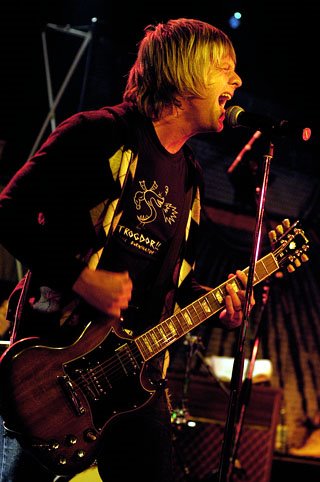
Here's a pic of Jon Foreman, lead singer/lyricis/lead guitarist of San Diego's sublimely awesome rock band, Switchfoot. Look more closely at him for more proof of his consummate coolness. Anyway, for any Switchfoot fans, I thought this might be a cool picture.
Subscribe to:
Posts (Atom)